
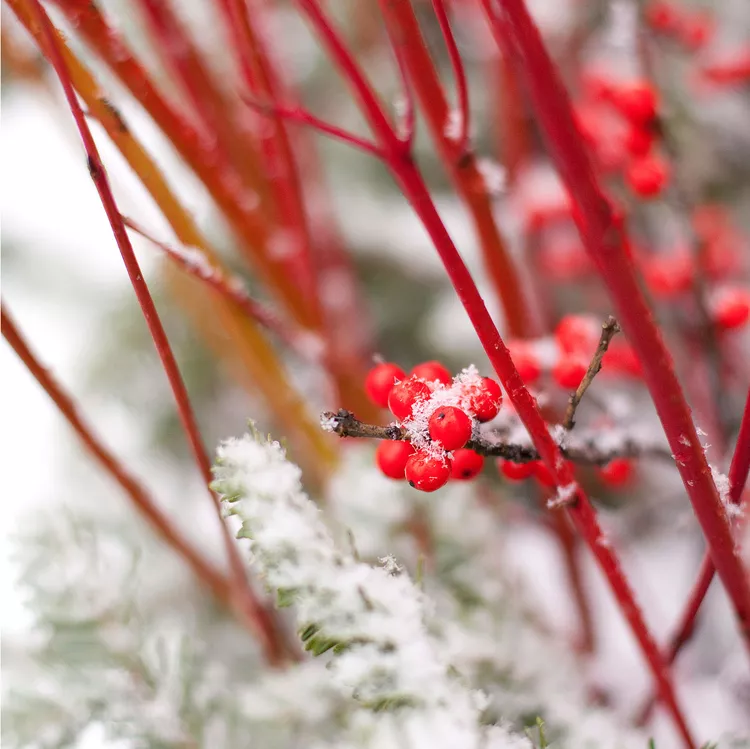
Let's face it: The winter landscape can look a little blah in comparison to the abundance of colors and textures in the other seasons. Most plants go dormant when the weather turns cold, leaving behind a drab palette of white, brown, and gray. However, you still can have a beautiful landscape that stands out against the stark backdrop of the quiet winter season. "If you want to be sure you have some winter interest in your garden, you are really looking at just a few things," says Barbara Pierson, nursery manager at White Flower Farm in Litchfield, Connecticut. From making strategic plant choices to creating colorful focal points, here are Pierson's best winter landscaping tips to help your yard shine in every season.
1. Focus On Bark
Deciduous trees lose their leaves in wintertime, leaving their branches and trunks in focus—but that can actually be a good thing, Pierson says. "If you have any interesting ornamental trees that have really visually distinctive bark, they will end up adding winter interest." Many of those trees and some shrubs are smaller, meaning they're easier to find spots for in the landscape. A few of Pierson's favorites include dogwood shrubs and birch trees, both of which offer outstanding winter color and texture.
2. Include Plants With Berries
Many trees and shrubs have berries they hold onto throughout the fall and winter, which can provide food for birds overwintering in your area. "Crabapples hold their little fruit," Pierson says, adding that they make a great addition to the winter landscape. "A holly bush with berries is also eally beautiful," she says.
3. Consider Evergreens
Evergreens are workhorses in the winter landscape for many reasons. First, there's color: Evergreens are not just green—they're also available in yellow (such as Gold Thread false cypress), blue (including dwarf blue spruce), and all the colors in between. Beyond that, evergreens just make good design sense, Pierson says. "They are really important for a winter landscape, but they make a good focal point all year-round," she says. "I always like to have at least one or two evergreens and work a border around those. When you're planting a new bed, you always want to include at least one evergreen."
4. Rely On Your Hardscape
Winter is a good time to critically assess your landscape and figure out where it's missing focal points. As it turns out, the solution to enhancing your winter garden might not be a plant at all. "Winter is the best time to consider hardscape," Pierson says. "A trellis, a garden bench, an arbor, even a garden sculpture, are really essential additions."
5. Dress Up Summertime Containers
Window boxes, hanging baskets, winter-hardy containers: All are indispensable for winter landscaping. Dwarf Alberta spruce and broadleaf evergreen shrubs—such as Japanese Andromeda, holly, and rhododendron—are perfect for wintertime, but they all have to be watered during dry periods. If you'd rather skip live plants, Pierson recommends filling containers with evergreen boughs of different textures, colors, and branches. "Anything with color in it," she adds.
6. Choose Four-Season Perennials
Some perennials have evergreen foliage, making them a great option for winter landscaping. Examples include some ornamental grasses and dianthus, which boasts beautiful, low-growing blue-green foliage. Hellebores also have evergreen leaves and even bloom in the winter. The further south you live, the more options you'll have for evergreen perennials. Even in colder northern areas, many perennials such as tall sedum and black-eyed Susan have attractive seed heads that add interest to the winter landscape if you leave them standing until spring.